
How Does a Pin Turning Boring Head Improve Machining Accuracy?
Machining accuracy depends on more than machine positioning and cutting parameters. The boring head also plays an important role in controlling hole diameter, dimensional consistency, and cutting stability. In this article, we explain how a Pin Turning Boring Head supports accurate boring operations, what specifications matter during tool selection, and how different configurations accommodate machining requirements. Drawing on our experience at Younio CNC Tools, we also examine practical considerations for selecting a suitable boring head for large-diameter hole machining.
Contents
- What Determines Accuracy in Boring Operations?
- How Does a Pin Turning Boring Head Improve Machining Accuracy?
- Key Technical Specifications and Configurations
- How to Select the Right Boring Head
- Typical Machining Applications
- Younio CNC Tools: Experience in Precision Drilling and Boring
- Frequently Asked Questions
What Determines Accuracy in Boring Operations?
In precision machining, producing a hole at the correct diameter is only part of the job. The finished bore must also meet dimensional tolerances, maintain acceptable roundness, and provide a consistent surface finish. These requirements become more challenging when machining large-diameter holes or working with components that require repeated production.
From our experience in cutting tool manufacturing, several factors directly influence boring accuracy:
- Tool rigidity: Insufficient rigidity can cause vibration and tool deflection, particularly when the cutting diameter or overhang increases.
- Cutting edge condition: Worn or incorrectly positioned inserts can affect dimensional consistency and surface quality.
- Diameter adjustment: The available cutting range must match the required bore dimensions without exceeding the tool's designed working limits.
- Tool holding compatibility: The holding diameter must match the machine-side connection or tool holder to ensure reliable installation.
- Machining parameters: Cutting speed, feed rate, depth of cut, and workpiece material all influence the final result.
A suitable boring head helps control these variables by providing an appropriate cutting geometry and configuration for the machining task. However, the final accuracy still depends on the complete machining setup, including spindle condition, workpiece clamping, tool installation, and cutting parameters.
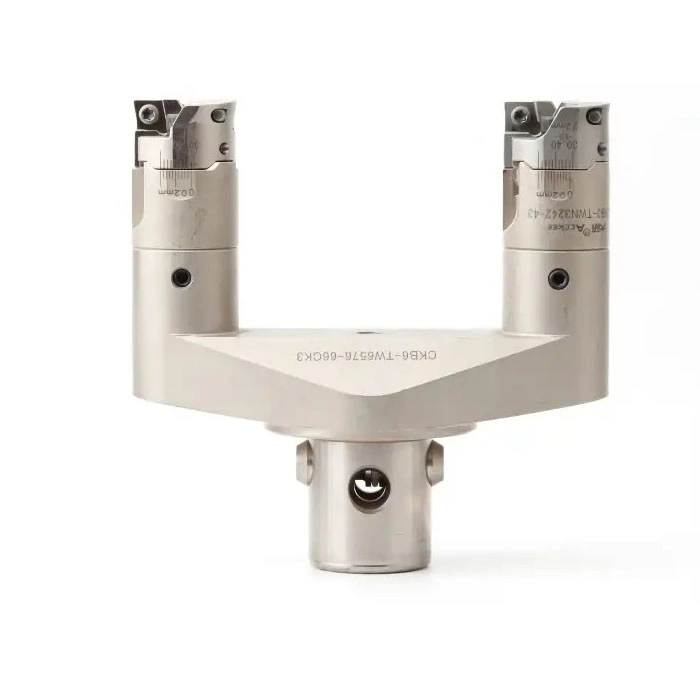
How Does a Pin Turning Boring Head Improve Machining Accuracy?
A Pin Turning Boring Head is used in boring and turning-related machining operations where controlled cutting diameter and reliable tool positioning are important. Its practical value comes from matching the cutting configuration to the required machining range rather than relying on a one-size-fits-all tool setup.
1. Supports Controlled Cutting Diameter
Cutting diameter is one of the first specifications we check when selecting a boring head. If the tool cannot cover the required diameter, the machining operation may need additional setups or a different tool configuration.
Our listed configurations cover cutting diameters from 80 mm to 222 mm. This range provides options for different large-hole machining requirements. Selecting a configuration close to the intended working diameter helps avoid unnecessary tool adjustments and makes the machining setup easier to manage.
2. Matches Cutting Depth to Machining Requirements
Cutting depth affects how much material the tool can remove in a machining operation. It should not be confused with the axial boring depth of the finished hole. The specified cutting depth is a tool configuration parameter and must be evaluated together with the workpiece geometry and machining process.
For example, our smaller configurations offer a listed cutting depth of 56 mm, while the larger configurations provide 67 mm or 77 mm. Choosing the correct configuration helps ensure that the tool is suitable for the intended cutting conditions.
3. Provides Compatible Tool Holding Dimensions
Tool holding compatibility is essential for stable machining. An unsuitable connection can introduce positioning errors or reduce the reliability of the cutting setup.
The available Pin Turning Boring Head configurations include holding diameters of 28 mm and 36 mm. Before ordering, we recommend checking the machine interface, tool holder dimensions, and required installation arrangement rather than selecting a tool based on cutting diameter alone.
4. Reduces Unnecessary Tool Changes
When a boring head covers the required cutting range, operators can avoid changing to another tool simply because the original configuration cannot reach the target diameter. This can simplify tool preparation and reduce setup interruptions.
For production environments machining multiple bore sizes, comparing the available diameter ranges in advance is particularly useful. It allows the machining team to plan tool allocation more efficiently while maintaining the appropriate cutting conditions for each operation.
Key Technical Specifications and Configurations
At Younio CNC Tools, we provide seven listed configurations of this boring head. The following table summarizes their main dimensional specifications to help machining engineers compare available options.
| Cutting Diameter (mm) | Holding Diameter (mm) | Length (mm) | Cutter Block | Cutting Depth (mm) | Outer Cutting Range (mm) |
|---|---|---|---|---|---|
| 80–88 | 28 | 79 | CKB2-TWN2533-38 | 56 | 22–30 |
| 90–98 | 28 | 89 | CKB2-TWN2533-38 | 56 | 32–40 |
| 119–129 | 28 | 118 | CKB3-EWN3242-43 | 67 | 45–55 |
| 129–139 | 36 | 128 | CKB3-EWN3242-43 | 67 | 55–65 |
| 139–149 | 36 | 138 | CKB3-EWN3242-43 | 67 | 65–75 |
| 182–195 | 36 | 179 | CKB4-EWN4154-50 | 77 | 89–100 |
| 209–222 | 36 | 206 | CKB4-EWN4154-50 | 77 | 114–127 |
What Do These Specifications Mean in Practice?
The table shows three main configuration groups:
- 80–98 mm cutting diameter: These two configurations use a 28 mm holding diameter, 56 mm cutting depth, and CKB2-TWN2533-38 cutter block.
- 119–149 mm cutting diameter: These three options use either a 28 mm or 36 mm holding diameter, with a 67 mm cutting depth and CKB3-EWN3242-43 cutter block.
- 182–222 mm cutting diameter: These larger configurations use a 36 mm holding diameter, 77 mm cutting depth, and CKB4-EWN4154-50 cutter block.
One point worth noting is that a larger cutting diameter does not automatically mean better machining performance. The correct choice depends on the required bore size, tool holding arrangement, workpiece material, available machine power, and cutting conditions.
How to Select the Right Boring Head
When choosing a boring head, we recommend checking the machining requirements in a specific order. This helps avoid selecting a tool based only on its nominal diameter.
Step 1: Confirm the Required Bore Diameter
Start with the finished hole diameter and the required dimensional tolerance. Compare the target size with the available cutting diameter range. For example, a machining requirement within 129–139 mm corresponds to the configuration with a 36 mm holding diameter and 67 mm cutting depth.
Step 2: Check the Tool Holder Interface
Confirm whether the machine setup accommodates a 28 mm or 36 mm holding diameter. Also check the actual connection structure and installation requirements. Matching the nominal holding diameter alone does not guarantee full interface compatibility.
Step 3: Evaluate Cutting Depth and Tool Length
Tool length and cutting depth should be considered together with the workpiece geometry. A longer tool may provide access to a particular machining area, but excessive overhang can increase deflection and vibration. We recommend using the shortest suitable setup that meets the machining requirements.
Step 4: Match the Cutter Block Configuration
The cutter block is another important selection detail. Our listed models include CKB2-TWN2533-38, CKB3-EWN3242-43, and CKB4-EWN4154-50. The specified block should be matched with the corresponding boring head configuration and compatible cutting components.
Step 5: Consider the Workpiece and Cutting Conditions
Workpiece material, hardness, machine rigidity, coolant conditions, and required surface finish all affect tool performance. A configuration that works well on one material may require different cutting parameters on another. Trial machining and dimensional inspection are useful before moving into batch production.
Typical Machining Applications
With cutting diameter configurations extending from 80 mm to 222 mm, this type of boring head can be considered for various large-hole machining tasks, subject to machine compatibility and the actual cutting process.
| Application Area | Typical Machining Requirement | Important Tool Consideration |
|---|---|---|
| Mechanical Components | Machining accurately sized internal bores | Cutting diameter and dimensional control |
| Industrial Machinery | Large-diameter holes in machine components | Tool rigidity and holding compatibility |
| Heavy Equipment Parts | Machining larger bore dimensions | Cutting depth and machine stability |
| Precision Manufacturing | Maintaining consistent bore dimensions | Tool setup and cutting edge condition |
For these applications, the boring head should always be selected according to the actual machine configuration, workpiece dimensions, and machining requirements. The cutting diameter range alone is not sufficient to determine whether a particular model is suitable.
Younio CNC Tools: Experience in Precision Drilling and Boring
Zhejiang Younio Tools Co., Ltd., operating under the name Younio CNC Tools, was established in 1983 and is headquartered in Wenling, Zhejiang, China. With more than 40 years of experience in cutting tool development and manufacturing, we specialize in U-drills, gun drills, and advanced machining solutions for hard materials.
Our manufacturing facility covers more than 80,000 square meters. Over the years, we have continued investing in manufacturing technologies and product development to meet changing requirements in industrial machining. Our products are now distributed through a global network covering more than 30 countries.
We understand that selecting an industrial cutting tool involves more than comparing product dimensions. Tool compatibility, machining stability, dimensional requirements, and the intended production process all need to be considered. That is why we focus on providing practical product specifications that support technical evaluation and tool selection.
For engineers and machining companies evaluating a Pin Turning Boring Head, we recommend confirming the target cutting diameter, holding diameter, cutter block, and cutting depth before finalizing a configuration. These details provide a more reliable starting point for selecting the appropriate tool.
To learn more about our machining solutions, visit Younio CNC Tools or contact our team with your machining requirements.
Frequently Asked Questions
1. What is a Pin Turning Boring Head used for?
A Pin Turning Boring Head is used in boring and turning-related machining operations where controlled cutting diameters and suitable tool configurations are required. It can support the machining of larger holes when matched with the correct machine interface and cutting conditions.
2. What cutting diameter range is available for this boring head?
The seven listed configurations cover cutting diameters from 80 mm to 222 mm. Individual options include 80–88 mm, 90–98 mm, 119–129 mm, 129–139 mm, 139–149 mm, 182–195 mm, and 209–222 mm.
3. What holding diameters are available?
The available models have holding diameters of 28 mm and 36 mm. The correct size should be selected according to the machine-side connection and tool holder specifications.
4. How does cutting depth affect boring performance?
Cutting depth is an important configuration parameter that determines the specified cutting capacity of the tool. The listed models provide cutting depths of 56 mm, 67 mm, or 77 mm. It should be evaluated alongside workpiece geometry, tool overhang, and machine rigidity.
5. How can I choose the correct cutter block?
Choose the cutter block according to the corresponding boring head model. The listed configurations use CKB2-TWN2533-38, CKB3-EWN3242-43, and CKB4-EWN4154-50. Confirm component compatibility before installation.
6. Does a larger boring head always provide better accuracy?
No. Accuracy depends on the complete machining system, including tool rigidity, spindle condition, workpiece clamping, cutting edge condition, and machining parameters. A larger tool is only appropriate when its diameter range and interface match the actual operation.
7. What information should I provide when selecting a boring head?
We recommend preparing the required bore diameter, workpiece material, machine and tool holder interface, required machining depth, and dimensional tolerance. These details make it easier to identify a suitable configuration and evaluate the machining setup.
Conclusion
Machining accuracy is the result of correct tool selection, stable installation, suitable cutting parameters, and consistent process control. A properly matched Pin Turning Boring Head helps establish the required cutting diameter and supports reliable boring operations across different workpiece sizes.
With seven configurations covering cutting diameters from 80 mm to 222 mm, Younio CNC Tools provides several options for evaluating large-diameter boring requirements. By checking the cutting range, holding diameter, cutter block, and cutting depth together, machining engineers can make a more informed tool selection and build a stable machining process.
Previous:No News
Send Inquiry


X
We use cookies to offer you a better browsing experience, analyze site traffic and personalize content. By using this site, you agree to our use of cookies.
Privacy Policy